

2-Turn Spiral Inductor with Air-Bridge
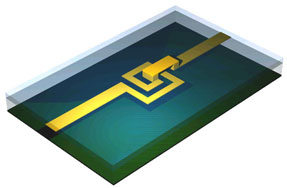

Above: This example shows a 1.5-turn microstrip series-configuration spiral inductor on undoped silicon (er = 10.2). Width and spacing of the inductor are both 10 mils. An air bridge with a height of 2 mils connects the center tap to the output microstrip line.
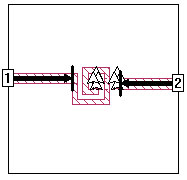 Layout of the circuit feed lines and spiral on the lower level in the project editor, sitting on a 10 mil Si substrate with ground plane below. Upward-pointing triangles indicate vertical vias going up from this layer. Dark arrows indicate reference planes for automatic de-embedding of the port discontinuities and connecting feed lines. The two vias support the metal bridge in air, on the layer above (not pictured).
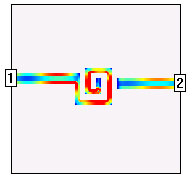 Surface current density (Jxy) on the spiral inductor at 10 GHz. Red indicates high current density, blue is low. Current density shown is displayed by the current density viewer in Sonnet Lite.
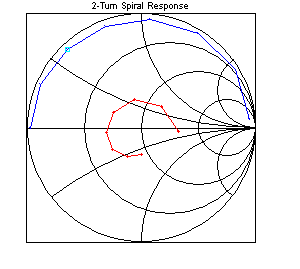 Response viewer display of Sonnet Lite output data. S11 (input return loss) is shown in the red graph, S21 (through parameter) is shown in the blue graph. Both traces move clockwise with rising frequency; data shown is 8-15 GHz.
This analysis required 1 Mbyte at the highest frequency of 15 GHz. This simulation may be performed using the Unregistered version of Sonnet® Lite. All results and graphics shown above were created using Sonnet Lite.


