
Sonnet Suites - Uniaxial Anisotropy Modeling
 Watch a Video on this subject
Uniaxial Anisotropy Modeling
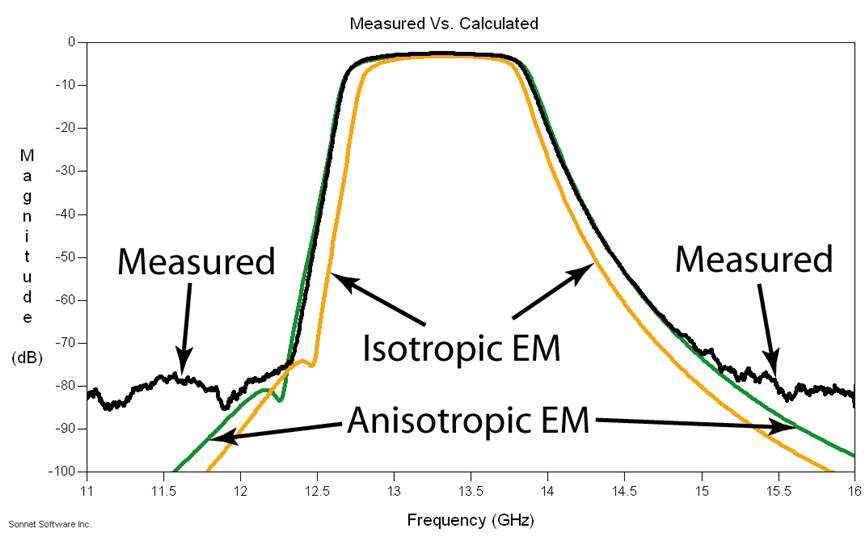
Sonnet simulation with anisotropy matches measurements well for a bandpass filter measured on an anisotropic ceramic material.
Data courtesy of Dielectric Laboratories-
click for large version
Any dielectric layer in a Sonnet geometry project may be defined to have uniaxial anisotropy. Uniaxial anisotropy allows the vertical dielectric constant and loss tangent to be different from horizontal. This is critical when designing with certain high-tech ceramics, sapphire, and any substrate that incorporates glass fibers. This includes widely used microwave substrates from Taconic and Rogers, even if the glass fibers are not in a woven fabric. Substrates like woven-glass PTFE and venerable FR-4 exhibit strong anisotropy. Loss tangent can be twice as large horizontally as compared to vertically and is also easily included in Sonnet. High frequency RF and digital designers can completely eliminate the risk of failure to include anisotropy effects on designs, and board manufacturers no longer need to compromise mechanical characteristics in an attempt to achieve isotropy.
Sonnet's Uniaxial Anisotropy Modeling for dielectric layers:
- Supports differing in-plane (X-Y) and out-of-plane (Z) dielectric properties
- May be used to control dielectric constant, loss tangent, conductivity, and magnetic properties for dielectric layers
- Enables accurate modeling for sapphire, FR-4 and other unique materials
- May be combined with equations and variable to include frequency, temperature or other dependencies
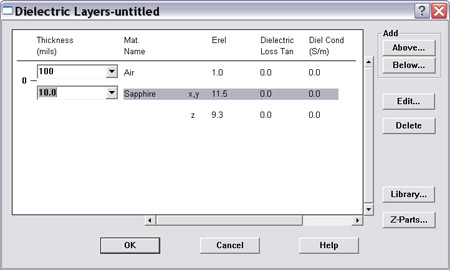
Sonnet dielectric properties window showing the uniaxial aniostropy definition for sapphire; XY and Z directed properties may be set independently
Uniaxial Anisotropy Modeling is available in Sonnet Professional versions only.


